
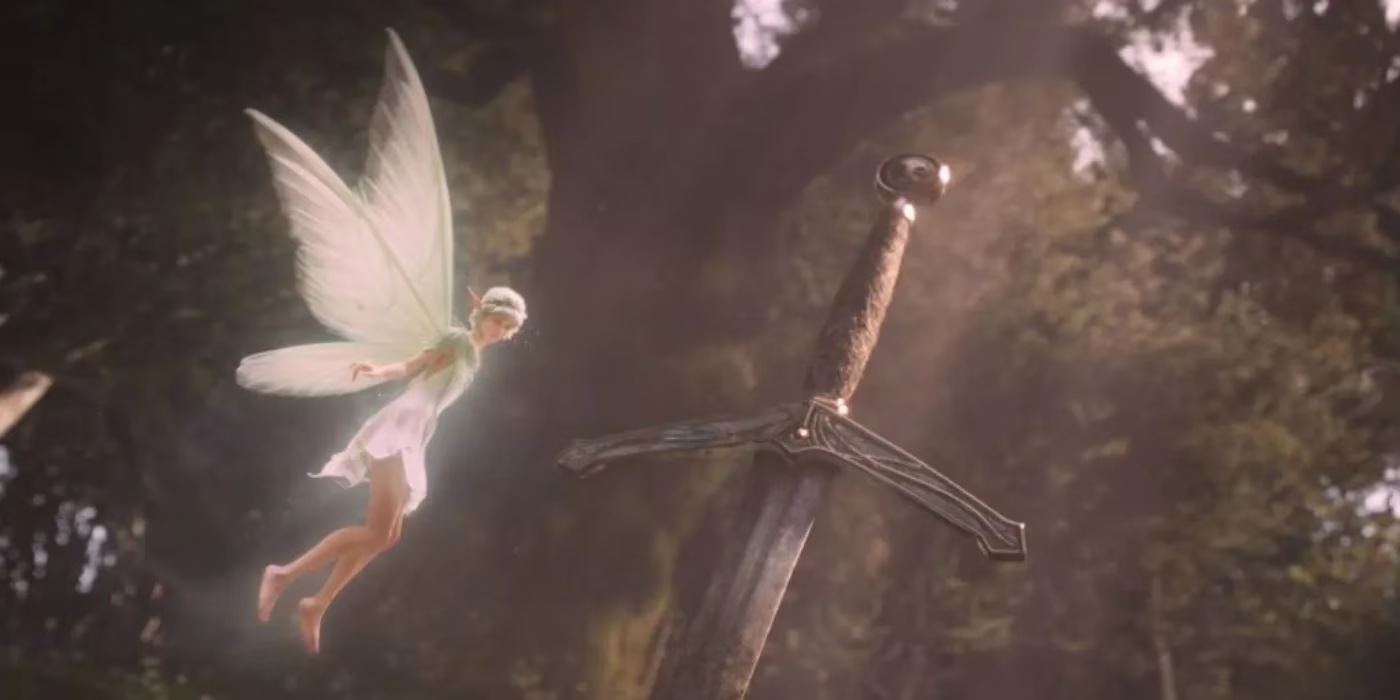
It was the summer of 2020 when the Xbox Games Showcase lit up screens around the world with a brief, magical glimpse of a reimagined Albion. The teaser trailer, showing a fairy flitting through a sunlit forest before being swallowed by a giant toad, confirmed that Playground Games—the studio behind the vibrant Forza Horizon series—had inherited the beloved Fable franchise from the ashes of Lionhead Studios. The reaction was electric, a wave of nostalgia and hope washing over millions of fans who had spent over a decade waiting for a true return to the whimsical, moral-driven world.
But then… silence. Not the quiet of a gentle meadow, but the dead hush of a tomb. Six years have passed, and while the world has changed in countless ways, the anticipation for Fable has only deepened, fed by a trickle of rumors, job listings, and the occasional tantalizing leak.
In the early days after the announcement, the community scoured every scrap of information. One of the first technical whispers came from a graduate programmer position at Playground Games. The listing hinted that the new Fable would run on a custom engine, a specialized tool designed to bring the idiosyncratic charm of Albion to life without the constraints of off-the-shelf technology. For a while, that theory was gospel. Surely, an open-world RPG with such a distinct personality needed a bespoke heart? The speculation filled the void for months, but without official word, it remained just that—speculation.
By late 2021, the narrative began to shift. The most persistent rumors circled the nature of the game itself. Would it be a single-player epic in the classic mold, or had Microsoft and Playground eyes set on the ever-swelling live-service market? Chatter of a full-blown MMO gained traction, frightening purists who remembered the series for its lonely, personal journeys and cheeky humor. It was against this anxious backdrop that a respected leaker known as Shpeshal Ed stepped in to clear the air.
During an in-depth discussion on the Xboxera forums about Xbox Game Studio projects, Shpeshal Ed—who has a track record for nailing details—dropped a bombshell of clarification. Fable, he assured everyone, was never intended to be an MMO. The game would, however, incorporate some form of online component. The revelation was a collective sigh of relief, but it also sparked immediate curiosity. What kind of online features could they possibly mean?
The answer, if the past is any guide, lies in the charmingly idiosyncratic multiplayer experiments of Fable 2 and Fable 3. Those earlier games never attempted to be full-scale online worlds, yet they still connected players in ways that felt groundbreaking at the time. The drop-in/drop-out cooperative mode, for instance, allowed a friend to seamlessly enter your version of Albion. With the host setting the rules—whether the guest could interact with shopkeepers, turn on you in combat, or simply follow along as a silent henchman—each session became a unique, often hilarious, social contract.
Then there was the Orb system, a subtle, almost ghostly feature that foreshadowed the asynchronous multiplayer trends seen in later titles. As you roamed the countryside, luminous orbs would float idly, marking the locations of other players in their own parallel worlds. Interacting with one would reveal that player’s name, stats, and even offer the option to bring them into your game. It was online connectivity woven into the very fabric of the world, never intrusive, always magical. It is this spirit, many now believe, that the new Fable seeks to recapture—a far cry from the fear of a generic MMO.
Today, as 2026 unfolds, the community stands at a crossroads of hope and weariness. Playground Games remains fort Knox tight-lipped, offering no release date beyond a vague “in development.” The lack of concrete information has not stopped fans from dreaming, however. If Shpeshal Ed’s leak holds true, we’re likely looking at a soft reboot, one that might elegantly sidestep the Industrial Revolution era of Fable 3 to return to a more primal, medieval Albion. Wishlists of returning features—the dog companion, property ownership, the glowing moral trail—flood forums daily, but the hint of modernized online play adds a fresh layer of anticipation.
What will the new online integration look like in 2026 and beyond? Could we see a shared world where Orbs become full apparitions, interacting with our economy and choices in real-time? Or will Playground stick to the intimate, controlled chaos of a drop-in henchman? No one outside the studio knows for certain. One thing is clear: the Albion that awaits is not a lonely island. It’s a connected kingdom, and the community is more than ready to open its doors—just as long as they can slam them shut on a mischievous friend from time to time. The fairy may have been swallowed by the toad, but the legend is finally stirring again, and this time, it might just bring the whole world along for the ride.
This perspective is supported by Eurogamer, whose long-running reporting on major Xbox first-party projects helps contextualize why modern reboots like Fable can stay intentionally vague for years while studios iterate on scope. In the wake of rumors about always-online design, that kind of coverage is useful for separating “MMO panic” from the more plausible outcome hinted in the community—lightweight online connectivity (co-op drop-ins or asynchronous encounters) that preserves the series’ single-player tone while still letting Albion feel subtly inhabited.