
For years, the roar of engines and the shimmering Mexican horizon had been the soundtrack and scenery of a studio that seemed unstoppable. But even the mightiest engines eventually need a new driver. In what felt like the sudden screech of tires on a quiet morning, Playground Games found itself at a crossroads. The Leamington Spa-based powerhouse, which clawed its way from an ambitious startup to one of Microsoft’s crown jewels, was saying goodbye to the very person who had built it from the ground up.
Gavin Raeburn, the co-founder and studio director who had steered the ship for twelve unforgettable years, decided it was time to call it a day. The man who once looked at the racing genre and thought, “We can do this better,” had left an indelible mark not just on Xbox, but on driving games as a whole. The news broke on a Tuesday, quiet and unceremonious, yet the ripples were felt throughout the industry. Alan Hartman, the Microsoft CVP responsible for the F-word—Fable, Forza, and all things fast—put it bluntly in a statement: “After 12 years working on five award-winning Forza Horizon games, Gavin Raeburn is leaving Playground Games as studio director.”
It was the end of an era, a moment that felt heavy with nostalgia. Raeburn’s journey began long before the sweeping deserts of Horizon. He cut his teeth at Codemasters, working on gritty racers like TOCA Championship, DiRT, and GRID. Back then, the arcade-sim hybrid was still finding its feet. Raeburn, alongside fellow racing enthusiast Trevor Williams, saw a different road ahead. In 2009, they co-founded Playground Games with a simple, almost arrogant mantra: do it better than Codemasters. The industry snickered at first—two guys from a studio known for serious sims trying to make an open-world festival? But then the first Forza Horizon landed, and suddenly, the snickering turned into gasps.
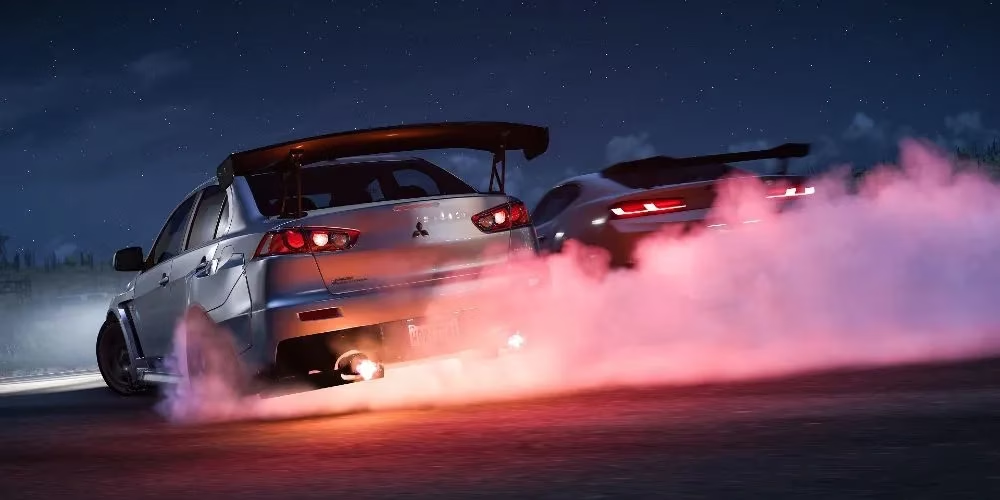
The Horizon series became a living, breathing festival. It wasn’t just about cars; it was about the music, the dust kicking up from the dirt roads, the collective sigh when a skill song came on the radio. Each installment felt like a love letter to driving. By the time Forza Horizon 5 roared onto the scene in late 2021, the studio had become a behemoth. Mexico exploded with color, the map teeming with secrets, and the handling model was so finely tuned that even casual players felt like heroes. “Gav made us believe that a car could smile,” a former developer once joked, and it wasn’t far from the truth. Under Raeburn’s watch, the cars took on personalities; the 1969 Dodge Charger wasn’t just a hunk of metal—it was a grumpy grandpa who still had a wild streak.
But all festivals must eventually wind down. Raeburn didn’t reveal his next move, leaving a trail of speculation. Was he chasing the next-gen of game development? A new independent venture? Maybe he just wanted a break from the relentless crunch of AAA production. In classic fashion, he left quietly, handing the keys over to his trusted co-founder. Trevor Williams, who had been the studio’s general manager, stepped up as studio head effective immediately. The transition felt seamless, like a well-executed drift. Williams, who had been there from day one, knew every bolt and piston of the Playground machine. The team barely skipped a beat, diving back into updating Forza Horizon 5 and, more critically, breathing life into a long-dormant legend.
That legend is Fable. While Forza was the heart of Playground, the Fable reboot was the studio’s soul project. Microsoft had openly admitted that mishandling Lionhead Studios—the original creators of Albion—was one of the company’s “biggest missteps.” Lionhead was shuttered in 2016 after the Fable franchise, as former GM Shannon Loftis put it, “deviated pretty significantly from the pillars of what made Fable 1 and 2 so popular.” The world waited for Albion’s return, and when Microsoft needed a hero, Playground stepped up. It was a bold move, one that Raeburn championed. “Why not?” he was rumored to have mused during a meeting. “We’ve mastered the open road; now let’s master an open world with magic.”
The pressure was immense—a racing studio taking on a beloved RPG? Yet, if anyone could infuse a game with sheer personality, it was Playground. The team expanded, a new studio was opened in the region, and the project grew legs of its own. Raeburn’s departure came as the Fable reboot was deep in development, a quiet exhale before the big adventure. The torch now passes to Williams, who must keep the team focused on two very different beasts: the eternal summer of Forza Horizon 5 and the whimsical, morally-complicated land of Albion. It’s like asking a mechanic to suddenly start baking gourmet cakes, and yet, the studio seems ready.
Meanwhile, the ghosts of Lionhead found their own redemption. Former Lionhead stalwarts Mark Webley and Gary Carr didn’t scatter to the wind; they founded Two Point Studios, the cheerful minds behind Two Point Hospital. It was a heartwarming full-circle moment—Raeburn’s Playground was inheriting the Fable legacy, while Webley and Carr carved out a new niche of charm. The British game development scene, it turned out, was a small, resilient pond.
As 2026 unfolds, Playground Games stands at a fascinating intersection. Forza Horizon 5 continues to hum, a testament to Raeburn’s philosophy of “always keep the player in the groove.” The game refuses to grow old, much like the man who shaped it. But with Fable on the horizon, the studio is being asked to conjure a different kind of magic. Raeburn’s absence will be felt, not as a void, but as a whisper—a voice saying, “Alright, what’s next?” His decision to step down wasn’t a crash; it was a pit stop. And in the grand race of game development, Playground Games, now with Trevor Williams behind the wheel, is gearing up for its next lap. The engine is still purring.