
I still remember 2020 like it was yesterday—the Xbox showcase where that shimmering fairy trail curved across the screen, and the words “Fable” bloomed in that familiar serif font. At first, my heart soared. The franchise that had taught me about consequence, humor, and the strange beauty of Albion was returning. But then, as the dust settled, a question wormed its way into my mind: Playground Games? The Forza Horizon studio? I’d spent countless hours tearing through Mexico and Britain in hypercars, chasing festival playlists with a grin plastered on my face. That was a world of throttle and tarmac, not morality meters and magic spells. I closed the trailer with a cautious whisper: “Let’s see if they can pull this off.”
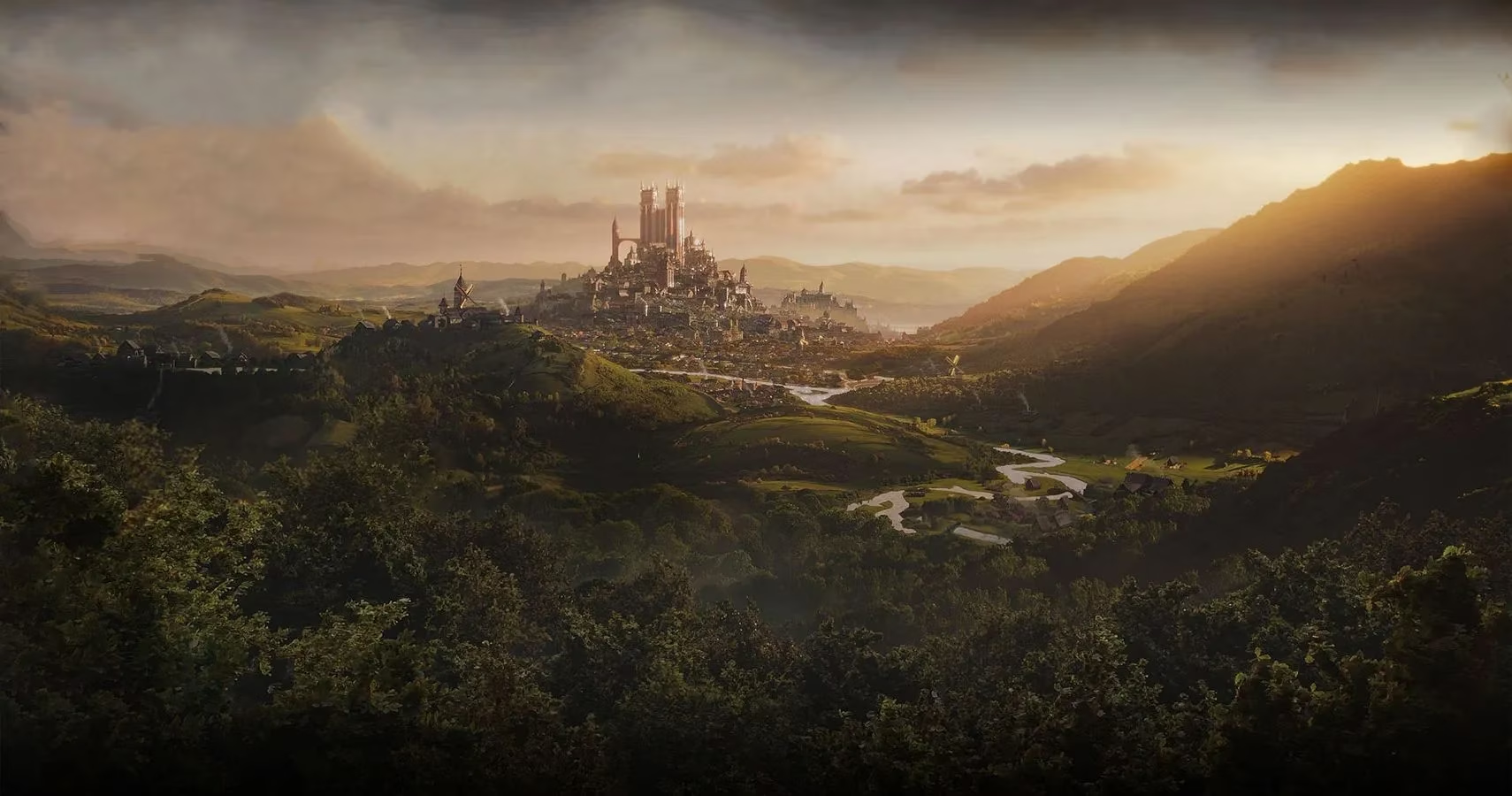
Six years later, in the reflective quiet of 2026, that whisper feels like a prophecy I both honoured and feared. The Fable reboot finally arrived in late 2025, and its journey from announcement to my console was one of the most dizzying emotional roller coasters I’ve ever ridden. To understand the game I now hold dear, you have to walk back through the fog of development—a period that at times felt less like game creation and more like a crew of rally drivers trying to paint a cathedral fresco. It’s a story best told not with dry timelines, but through the eyes of a player who watched and waited.
The Unlikely Architect
When Playground Games took the reins, I dug into every scrap of news. The studio’s pedigree was stellar—Forza Horizon 4 and 5 were masterpieces of open-world design, bursting with personality and seamless multiplayer. But an RPG isn’t a racing festival. It’s a slow-brewed potion, demanding systems of choice, deep narrative threads, and a combat cadence that rewards patience over reflexes. Racing games, by contrast, are all about immediate feedback: brake, apex, accelerate. The gap between the two felt like asking a sprinter to sculpt marble. That metaphor isn’t lazy; it’s exactly how the early months must have felt, based on everything we later learned.
Ex-developer Juan Fernandez, in a candid 2021 interview with Spanish outlet Vandal, pulled back the curtain. He described a team of brilliant minds who “lacked people with the knowledge of how gameplay is done” for a slow-paced RPG. His words resonated with me like a warning bell. They were, in his telling, “very smart” but trapped in a paradigm where open-world meant roads, events, and a car under your feet. Controlling a character—the weight of a sword swing, the nuance of a dialogue wheel—was alien territory. I pictured the office as a ship full of master sailors suddenly asked to fly a biplane; the instruments looked the same, but the sky demanded a different language.
The Slow Grind of “More with Less”
Fernandez didn’t stop there. He highlighted Playground’s “doing more with less” mentality—a noble philosophy that can backfire like a blacksmith trying to forge a crown with only a hammer and anvil from his workshop. Without the specialized tools, each nail takes ten strikes, and the arm grows weary. Development became, in his words, “longer and longer,” a glacier carving a valley with excruciating deliberation. The project had been underway for at least four years when Tom Golton, Playground’s lead engineer, casually mentioned his tenure in November 2020. If you do the math, that pushed the starting line somewhere around 2016—long before the public teaser. A game that spent nearly a decade in gestation isn’t just overdue; it’s a beast that’s been fed countless iterations, discarded prototypes, and the sweat of a team learning from scratch.
I remember the anxious forums, the Reddit threads filled with equal parts hope and despair. Each Xbox event that passed without a Fable update felt like a missed heartbeat. The 2023 release window mentioned by insiders came and went, replaced by radio silence. By 2024, we got a haunted-looking trailer with a few snippets of combat, and my friends and I dissected it frame by frame. The combat looked weighty but not quite there—like a dancer still counting steps. The magic effects, however, shimmered with the old Fable charm. It was a tease wrapped in a promise, and I clung to it.
A Seed Planted in Stormy Soil
What I didn’t appreciate back then was the quiet transformation happening behind the curtain. Fernandez left during that turbulent period, but he noted that Playground had already begun “hiring more staff”—seasoned RPG developers who could water the seed of Albion with proper horticultural knowledge. That influx, I suspect, was the real turning point. The game I finally played in 2025 wasn’t the product of a racing studio fumbling in the dark; it was the fusion of two worlds. The open-world splendor of Forza Horizon—the breathtaking vistas, the lived-in feeling of a landscape—had been married to a quest system that genuinely reacted to my choices.
Walking through a bustling Bowerstone market for the first time, I felt the same organic delight I used to get discovering a hidden speed trap off a dirt road. The spellcasting had a rhythm that reminded me, bizarrely, of finding the perfect racing line: timing, flow, and a satisfying payoff. And the humor? Oh, the classic Fable cackle was there, tucked into side quests and pub signs. It was as if Playground had taken its engine of joy and simply changed the tires and chassis—the soul of exploration remained identical.
The 2025 Landing and a Player’s Verdict
By the time the disc spun in my Xbox, the game had been polished into something that felt both nostalgic and refreshingly new. The “doing more with less” ethos had eventually forced a kind of creative elegance: menus were cleaner, mechanics were streamlined without being shallow, and the world felt densely packed with secrets rather than bloated with filler. The decade-long development, once a symbol of crisis, became the very reason the game felt hand-stitched.
Critics initially balked at the 2025 release, pointing to the tumultuous journey, but players like me—who had weathered every rumor and delay—saw the scars as battle medals. The reviews eventually warmed over time, much like the original Fable’s reputation. In 2026, the DLC “The Lost Kingdom” is already rumored, and the community is buzzing with fan theories, mod ideas, and the same kind of unhinged chicken-kicking videos that made Fable legendary.
Looking back, the Fable reboot’s odyssey teaches an odd lesson: sometimes, the most memorable stories aren’t the ones told on screen, but the ones whispered in the wings. Playground Games was a cheetah forced to learn a waltz; for a long time, it stumbled, but when it finally found the rhythm, the dance was worth every aching year. I still boot up Forza for my speed fix, but now Albion is the place I go to breathe.
In the end, the Fable reboot didn’t just survive its gauntlet—it emerged as something that could only have been forged by a team that refused to stay in its lane. And for a player who paid his dues in patience, that victory tastes sweeter than any 60-second lap record.